
Marin · Portable Restroom Rentals
Portable Hand Washing Stations
Free-standing sinks with fresh water, soap and towels, for construction sites, caterers and outdoor events.
Handwashing Stations · Marin
What A Portable Sink Rental Includes
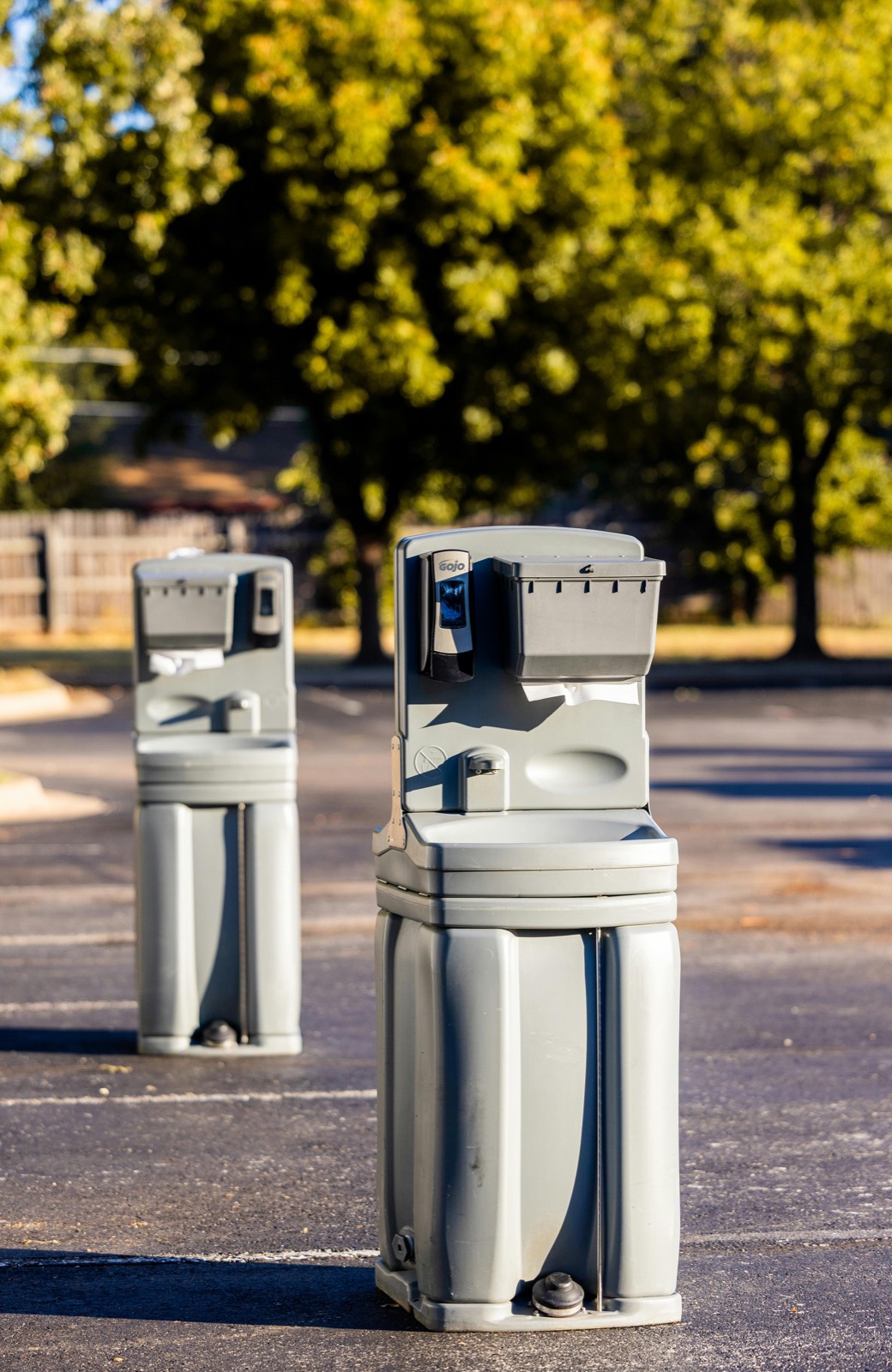
A portable hand washing station is a free-standing sink with its own fresh-water tank, a foot-pump or pressurized faucet, soap, paper towels and a sealed greywater tank underneath. Nothing drains onto the ground and nothing needs to be plumbed in. The standard two-station unit serves both sides at once and holds enough water for several hundred washes between service visits; hot-water models add a small heater and are what caterers and food trucks are usually asked for. We rent them across Marin County to construction sites, where OSHA 1926.51 requires accessible hand washing, and to events with food service, where the county health department expects it. Most go out alongside a portable toilet rental, which costs less than ordering either on its own because it is one delivery and one service stop.
Why Rent Your Sinks From Us
Hand washing stations are the item most likely to be forgotten until an inspector or a caterer asks about them, and then they are needed the same week. Because we run our own route out of San Rafael and stations travel on the same trucks as the toilets, adding one to an existing rental is usually a day or two rather than a new order with a new lead time. Keeping the water topped up is the other half of it: a station with an empty tank is worse than no station, and it is exactly what happens when servicing is treated as an afterthought.
- Added to an existing rental in a day or two, with no separate delivery charge when it goes on the same stop.
- Fresh water, soap and towels refilled on the same weekly visit as the toilets are pumped.
- Hot-water units available for catering and food service, where cold-water foot pumps are not enough.
- Sealed greywater tanks pumped out at every service, so nothing discharges onto the ground.
- We spec the station-to-worker ratio for job sites rather than sending one unit and calling it done.
- Same-day and next-day fills on event weekends where usage runs harder than expected.
Reasons To Rent A Hand Wash Station
Most orders come from one of these:
OSHA requires it on your construction site
OSHA 1926.51 requires accessible hand washing facilities on construction sites. A sanitizer dispenser inside the toilet does not satisfy it by itself, and this is a common citation because it is so easy to overlook.
There is food service at your event
Caterers, food trucks and any temporary food facility need accessible hand washing to meet county health rules. Marin County environmental health will look for it at permitted events, and caterers will often ask before they will work a site.
The restrooms are a long way from the work or the food
Hand washing has to be within easy reach of both. When the toilets are at one end of a site and the crew or the catering tent is at the other, a station at each end is the fix.
The site or event involves children
Petting zoos, school events, sports days, art fairs with messy activities. Parents look for somewhere to wash hands, and a station is a small cost against how much better it makes an event feel.
You are working somewhere with no running water
Ranch work, trail crews, vineyard jobs, disaster response and temporary base camps. Self-contained stations are the only practical option, and they carry enough water to be genuinely useful rather than symbolic.
Your general contractor asks for one
Many managed sites in Marin require hand washing as site policy regardless of the crew size. If you are a sub mobilizing onto a job, check before you arrive rather than after.
Tell us the headcount or the guest numbers and whether food is involved, and we will spec it and quote it on the call. Call: 415-322-7715
How We Work
Quote on the phone, delivery in two days, weekly service on a fixed day, pickup when you say.
1. Picking the right unit
Cold-water foot-pump stations cover most construction work. Food service, and anything where the county health department is issuing a permit, usually needs a hot-water unit with a 110V supply or an inverter. We ask which it is before quoting.
2. Delivery and placement
Stations go beside the toilets on a job site and next to the catering area at an event, always on level ground within reach of a service truck. Delivered alongside your other units, so it is one visit.
3. Weekly service
Fresh water refilled, soap and paper towels restocked, greywater tank pumped out, faucet and pump checked. This runs on the same weekly stop as the toilet servicing rather than as a separate visit.
4. Pickup
Collected with the rest of the order when the job or the event ends, with the removal already inside the quoted price.
Station Types And Site Requirements
The variations that come up when we spec an order:
Two-station foot-pump sinks
The standard unit: two basins, foot-operated pumps, soap and paper towel dispensers, fresh and greywater tanks onboard. No power, no plumbing, nothing required from the site. This covers the great majority of construction work in Marin.
Hot-water and food-safe stations
A small inline heater gives genuinely warm water, which is what caterers and food handlers are usually required to have. These need a 110V outlet or an inverter, so the site has to be able to supply that.
How many stations a site needs
On construction, roughly one station per two toilet units, or one per ten to twenty workers depending on the site layout. On events, one near each cluster of facilities and one at the catering area is the sensible arrangement.
Where the greywater goes
Into a sealed tank inside the unit, pumped out at every service visit. Nothing drains to the ground, which matters on creek-side sites in San Anselmo and Fairfax and on any job near the bay margin.
Stations built into restroom units
Some toilet models include a small onboard sink. It is better than nothing and it is generally not enough to satisfy the OSHA requirement on a construction site, which is why we quote a separate station on job orders as a matter of course.
Pairing with restrooms and trailers
A station beside a bank of construction porta potties is the normal job site layout. At events with a wedding trailer, the trailer has its own sinks and the standalone station goes to the catering tent instead.
High-use event weekends
A busy festival or a hot day can empty a fresh-water tank faster than expected. We can schedule a mid-event fill, and on the larger public events in Marin that is usually the right call rather than a gamble.
What A Portable Sink Rental Costs
A standard two-station foot-pump sink runs roughly $75 to $150 a month on a job site rental when it goes out with toilets, and $75 to $150 for a weekend event. Hot-water units cost more. What moves it:
- Whether it is bundled. A station added to an existing order shares the delivery and the service stop, which makes it substantially cheaper than a standalone rental.
- Cold or hot water. Foot-pump units are the affordable baseline. Hot-water food-service units cost more and need a power supply on site.
- How many stations. Additional units on the same site are cheaper than the first, and the ratio to your toilet count is what we work from.
- Service frequency. Weekly refills are included on monthly rentals. Heavy event use can need a same-day fill, quoted separately.
- How long the rental runs. Monthly rates discount heavily against daily, which is why job site stations are always priced by the month.
- Distance. Free within our service area when it goes out with an existing order; quoted with mileage for the coast and West Marin.
Most people bundle a station with their toilets, so tell us the headcount and we will quote both together. Job site pricing sits on the construction porta potty page, and the whole range of units we run across the county is on our portable toilets, trailers and sinks overview.
Frequently Asked Questions
Do I need a hand washing station if I already have portable restrooms?
On a construction site, almost certainly yes. OSHA requires accessible hand washing within easy reach of the toilets, and the sanitizer dispenser inside the unit does not satisfy that on its own. Some restroom models have a small built-in sink, but most job sites need a separate station.
Can you do hot water?
Yes. We rent hot-water units for food service and for industrial sites that require them. They need a 110V outlet or a small inverter on site, so tell us when you book and we will confirm what the location can supply.
How often do you refill the water?
Once a week as standard, on the same visit that services your toilets. Heavy-use sites can go to twice weekly, and busy event weekends can have a same-day fill scheduled, which is worth doing on a hot day with a big crowd.
Where does the waste water go?
Into a sealed greywater tank inside the unit, which we pump out during the weekly service. Nothing drains onto the ground, which matters on the creek-side and bay-margin sites we work on around Marin.
How many stations does my site need?
A reasonable rule is one station per two toilet units, or one per ten to twenty workers depending on how spread out the site is. At events, put one at each cluster of facilities and one at the catering area, because the caterer will want it separate from the guest queue.
Can a station go anywhere on the site?
It needs level ground and access for the service truck, same as everything else we deliver. Beyond that, put it where people actually are: beside the toilets on a job site, and next to the food on an event site. A station nobody walks past does not get used.
Need a restroom in Marin?
Dates, numbers and an address are all we need. We call back inside one business hour with a free estimate and a flat price.
Or call us now: 415-322-7715